

- Home
- Blog
- Tattoo Ideas
- Black and Grey vs Fine Line Tattoos: Dragon, Floral & Car Portfolio | Sutran Tattoo Studio Hanoi
Black and Grey vs Fine Line Tattoos: Dragon, Floral & Car Portfolio | Sutran Tattoo Studio Hanoi


Short answer: A black and grey tattoo uses diluted black ink and shading techniques to build depth, contrast and three-dimensional form, making it the stronger choice for large subjects like dragons, florals and portrait-style work. A fine line tattoo uses a small, consistent needle grouping to draw crisp outlines with little or no shading, making it ideal for delicate, illustrative pieces such as a vintage car, script or minimal botanicals. At Sutran Tattoo Studio in Hanoi, we recommend black and grey when you want the tattoo to read as a solid image from across a room, and fine line when you want a subtle drawing that lives close to the skin.
Black and grey vs fine line: the quick comparison
- Ink and palette: Black and grey relies on black ink plus grey wash (black diluted with distilled water or a mixing solution). Fine line is usually line-only, pure black, with minimal or no grey.
- Needles: Black and grey work moves between liners, magnums and soft-edge shaders. Fine line typically stays on tight 1RL to 3RL round liners.
- Session length: A half-sleeve black and grey piece is commonly built across multiple sessions of 3 to 5 hours. A palm-sized fine line design can often be finished in 1 to 2 hours.
- Visual impact: Black and grey holds contrast at distance. Fine line reads best within one to two metres.
- Ageing: Solid blacks and mid-greys age predictably. Very thin lines soften and spread more noticeably over 5 to 10 years, especially on high-friction placements.
- Best subjects: Black and grey for dragons, koi, florals with volume, realism, statues, lanterns. Fine line for vehicles, architecture, single-stem plants, small symbols, handwriting.
What is a black and grey tattoo, and why do Hanoi clients choose it?
Black and grey is the oldest surviving tattoo language in the world: one pigment, many values. Instead of relying on colour to separate elements, the artist controls saturation. A dark, packed area sits forward; a soft grey wash falls back; untouched skin becomes the highlight. Done well, a black and grey tattoo behaves like a charcoal drawing that happens to live under your skin.
In Hanoi we see three practical reasons clients pick it. First, it suits Southeast Asian skin tones across the full range, because contrast is built from value rather than from colour that must compete with underlying melanin. Second, it heals more forgivingly in a humid climate where colour packing can be slower to settle. Third, it fits the visual vocabulary many of our clients already love: Asian traditional dragons, temple architecture, lotus and cherry blossom, calligraphy and folklore imagery.
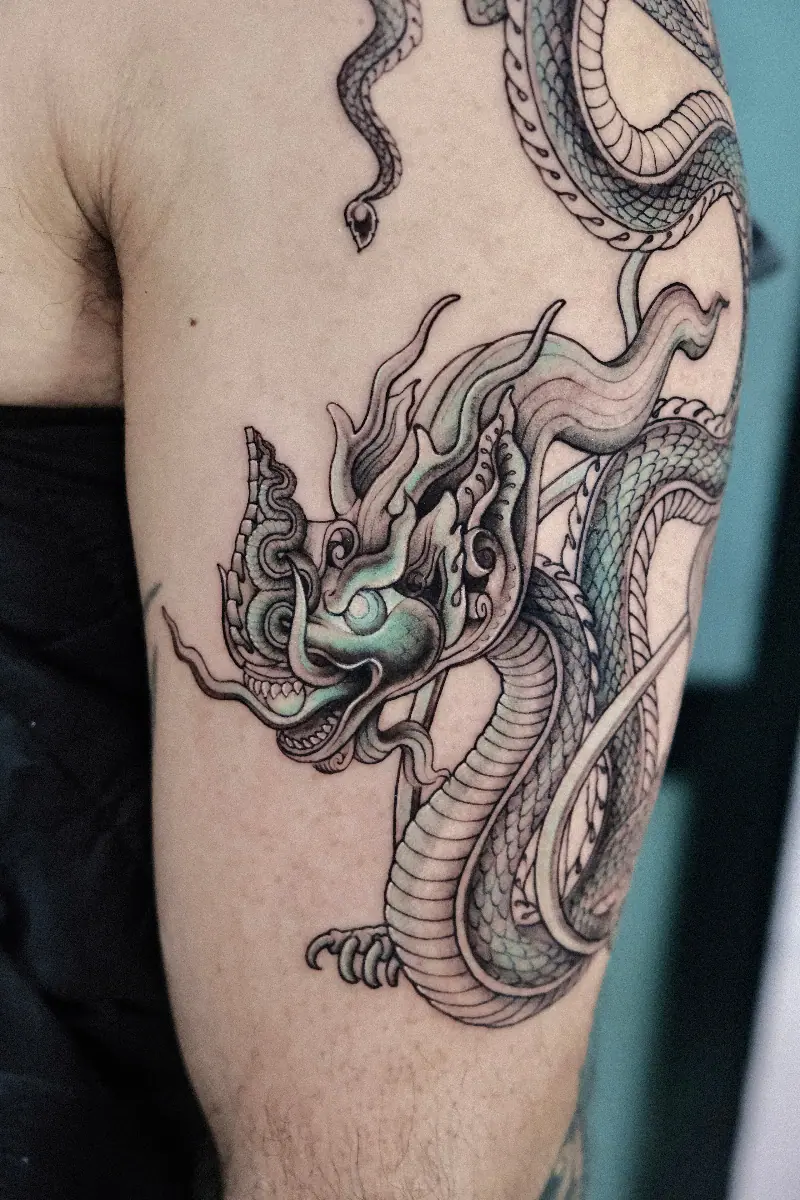
Portfolio piece: Asian traditional dragon, upper arm
One of the clearest examples in our Hanoi portfolio is a detailed black and grey Asian-style dragon that wraps around the upper arm, finished with subtle green accents. Two things make this piece work technically. The first is flow: the body of the dragon follows the curve of the deltoid and bicep, so the design is never cut off awkwardly when the arm hangs at rest. The second is value planning. Scales, mane, claws and clouds all compete for attention, so the artist decided in advance which zones would carry the darkest blacks and which would be left as open grey and skin. Without that plan, an Asian traditional dragon turns into visual noise within a few years as the tattoo settles.
The subtle green accents show a useful middle path many clients do not know exists. You do not have to choose between full colour and pure monochrome. A restrained accent, used on one or two elements, keeps the black and grey structure intact while adding a single point of warmth.
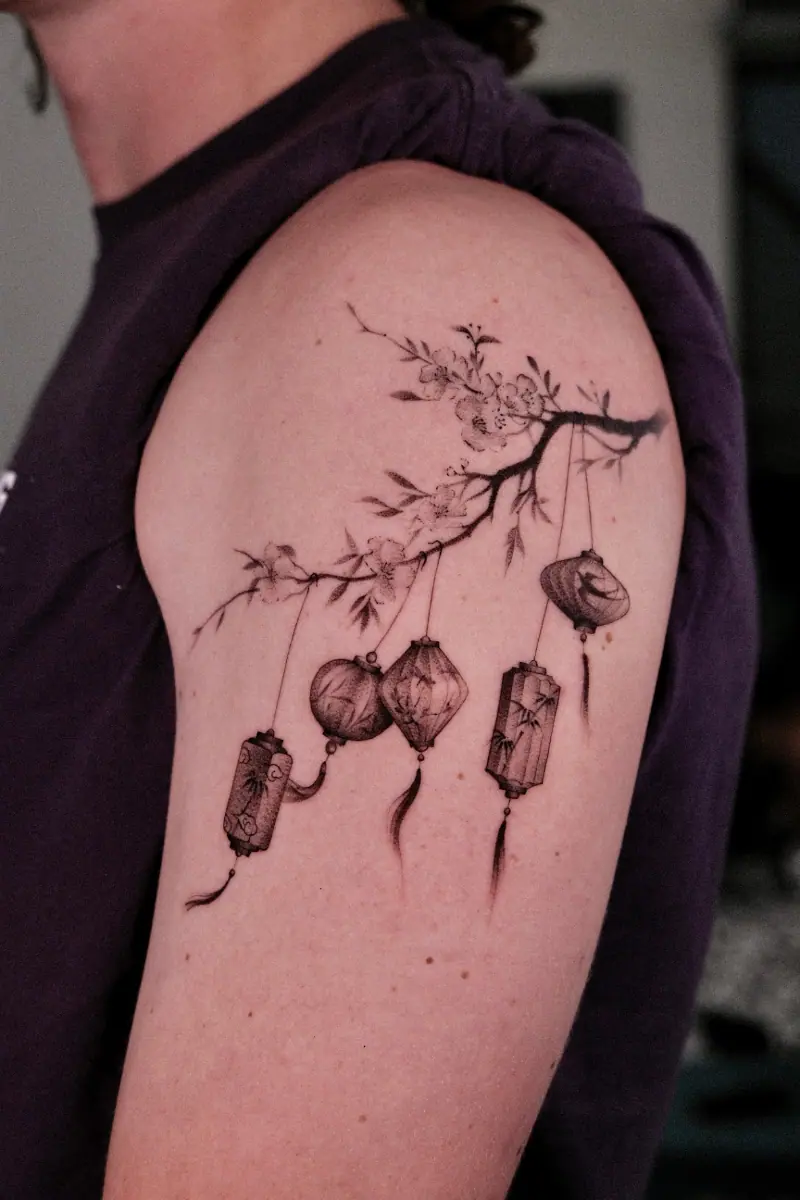
Portfolio piece: cherry blossom branch with hanging lanterns, upper arm and shoulder
A second black and grey piece from the same studio wall shows a cherry blossom branch with five hanging Asian-style lanterns, placed across the upper arm and shoulder. This design demonstrates why florals are often better in black and grey than in fine line. Petals need soft edges to look like petals. Lanterns need interior shading to look like three-dimensional objects with light inside them rather than flat paper cut-outs. Both effects come from graduated grey, not from outline weight.
The composition also teaches a placement lesson we repeat daily in Hanoi: vertical, hanging elements suit the shoulder and outer upper arm because the natural line of gravity matches the line of the design. Five lanterns give the eye a rhythm to follow from shoulder down toward the elbow, which is exactly how a viewer reads an arm in real life.
What is a fine line tattoo, and when is it the right call?
Fine line tattooing prioritises the drawing itself. The artist uses a very small needle grouping, low voltage and a steady, single-pass hand to lay down a consistent line with as little trauma as possible. There is no shading to hide behind, so line quality, spacing and symmetry are fully exposed. It is a style that rewards experience and punishes rushing.
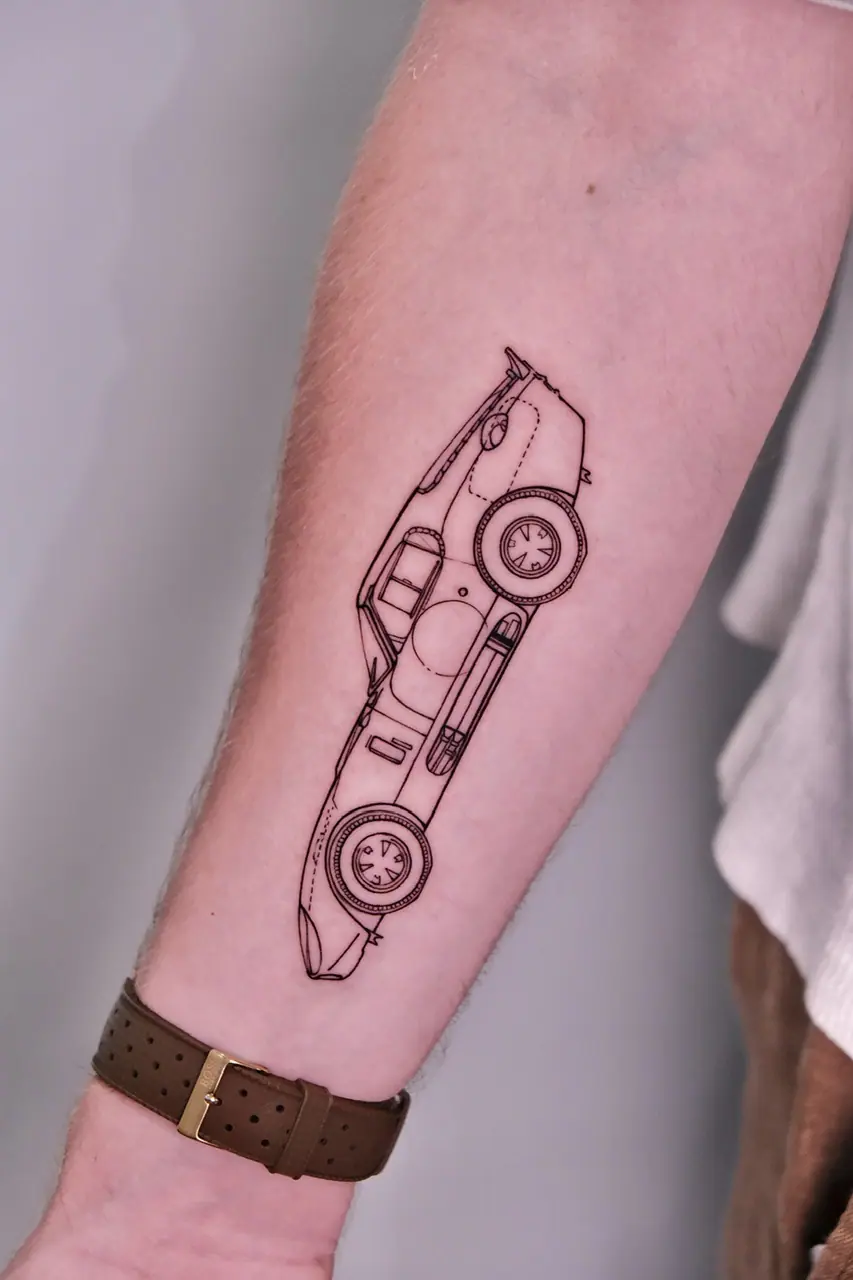
Portfolio piece: vintage sports car, forearm
Our fineline classic car tattoo, a vintage sports car outlined in black ink on a forearm, is a good demonstration of the style’s strengths. A car is defined almost entirely by its silhouette and panel lines: the curve of the wing, the chrome trim, the wheel arches. Rendering it in line-only ink keeps the design light and technical, like a blueprint or a sketch from a design studio, and it avoids the heaviness that a fully shaded car can bring to a slim forearm.
Fine line also has real limits, and we tell clients about them before the needle touches skin:
- Line spacing matters. Lines placed too close together can migrate toward each other over years and read as a solid grey mass. We design gaps intentionally.
- Placement affects lifespan. Fingers, palms, feet and the inner wrist rub, stretch and shed faster. Forearm, inner bicep and calf hold fine line far better.
- Sun is the main enemy. In Hanoi’s summer UV levels, unprotected fine line fades measurably faster than solid black work.
- Scale limits detail. A car that works at 15 cm may lose its interior lines at 7 cm. We scale detail to size rather than shrinking a drawing.
How to choose between the two styles
Ask these five questions
- How far away should it read? Across a room means black and grey. Up close means fine line.
- Is the subject organic or mechanical? Scales, petals, fur, smoke and cloth need shading. Machines, maps and typography survive on line alone.
- How much skin are you covering? Anything above roughly 15 cm usually needs grey value to avoid looking empty.
- What is your maintenance appetite? Fine line benefits from a refresh every few years. Black and grey usually does not.
- Do you plan to expand later? Black and grey connects into sleeves more naturally, because grey wash can bridge separate designs.
Many of our Hanoi clients end up with both: a black and grey statement piece on the arm and one or two fine line pieces elsewhere. The styles coexist well as long as they occupy different zones of the body rather than sitting side by side.
Hygiene, safety and standards at our Hanoi studio
Style is only half of a good tattoo. The other half is process. At Sutran Tattoo Studio in Hanoi we follow the same protocol for a 30-minute fine line piece and a 5-hour black and grey session:
- Single-use, pre-sterilised needles and cartridges, opened in front of the client and disposed of in a sealed sharps container.
- Single-use ink caps, razors, grip covers, clip cord sleeves and machine bags; ink is never returned to a bottle after decanting.
- Reusable equipment cleaned, bagged and autoclave-sterilised, with barrier film on every surface the artist touches during a session.
- Fresh nitrile gloves per client and glove changes at every break in the procedure.
- A pre-session consultation covering medical history, skin conditions, medication, allergies and recent sun exposure. We reschedule sunburned or freshly peeling skin.
- Written aftercare instructions in English and Vietnamese, plus a follow-up check so we can catch healing issues early.
Artist expertise
Our artists specialise rather than generalise. The team members who build Asian traditional dragons and black and grey florals work primarily in shading and composition, while our fineline artists spend their hours on line consistency and geometry. When a design sits between the two, we discuss it together before quoting, because the honest answer is sometimes that a subject you saw online in fine line will hold up better in black and grey at the size you want.
Aftercare in Hanoi’s climate
Hanoi’s humidity, summer heat and monsoon season affect healing more than most clients expect. Our standard guidance:
- Keep the fresh tattoo covered as instructed, then wash twice daily with clean hands and fragrance-free soap.
- Apply a thin layer of aftercare ointment. Thick layers trap moisture and sweat in humid weather.
- Avoid pools, lakes, the gym and long motorbike rides in dusty traffic for the first two weeks.
- No direct sun on the healing tattoo. After healing, use SPF 50 daily, especially on forearm fine line work.
- Expect black and grey to look lighter around week three. Grey wash settles and regains contrast as the skin fully recovers.
Book a consultation in Hanoi
If you are deciding between a black and grey tattoo and a fine line piece, bring your references to the studio and we will mock the design onto your body with a stencil at real size before booking. Seeing an Asian dragon wrap your actual upper arm, or a classic car sit along your actual forearm, answers the question faster than any article can. Sutran Tattoo Studio welcomes residents, expats and visitors in Hanoi, and consultations are free.
RELATED POST

Chi Phí Xăm Hình Ở Sài Gòn: Các Tình Huống Thực Tế Và Mức Giá Tham Khảo
31 August 2026
Tattoo Prices in Saigon: What People Actually Pay (Real Scenarios)
31 August 2026

Tattoo in Vietnam: Hanoi vs Ho Chi Minh City — Where Should You Get Inked?
29 August 2026
Xăm Hình Ở Hà Nội Hay TP.HCM: Chọn Nơi Nào Cho Trải Nghiệm Tốt Nhất?
29 August 2026

Getting a Tattoo in Hanoi’s Old Quarter: A Traveler’s Guide
28 August 2026
Xăm Hình Ở Phố Cổ Hà Nội: Trải Nghiệm Đáng Nhớ Cho Chuyến Đi
28 August 2026