

- Home
- Blog
- Tattoo Ideas
- Religious & Spiritual Tattoo Designs: Meanings and Etiquette
Religious & Spiritual Tattoo Designs: Meanings and Etiquette


Religious and spiritual tattoos are some of the most personal pieces a client will ever commission — they’re rarely about trend and almost always about faith, memory, or a turning point in someone’s life. Crosses, Buddhist symbols, Marian imagery, mandalas, and scripture lettering all fall under this category, and each carries its own weight depending on the tradition it comes from. At Sutran Tattoo Studio, we get asked about this category often enough that it deserves its own guide — including a few cultural points that are genuinely worth knowing before you book.
What Religious and Spiritual Tattoos Represent
At their core, these designs are a way of wearing belief rather than just describing it. A cross can mark a moment of faith or loss. A lotus or Buddha figure can represent a personal practice of mindfulness rather than formal religious membership. A mandala, with its layered geometry, is often chosen less for a specific doctrine and more for what it symbolizes universally: balance, wholeness, and the idea that everything complicated eventually resolves into a pattern. For a lot of clients, the appeal isn’t organized religion at all — it’s the sense of protection, guidance, or grounding that these symbols have carried for centuries.
Popular Symbols Across Faiths and Traditions
Because “religious tattoo” covers so much ground, it helps to think in terms of specific traditions rather than one broad style:
- Christian imagery — crosses, rosaries, the Virgin Mary, sacred heart, and scripture verses in fine-line script
- Buddhist imagery — Buddha figures, lotus flowers, prayer beads, and Sanskrit mantras
- Hindu-influenced symbols — Om, mandalas, and lotus motifs, often rendered in dotwork or geometric linework
- General spiritual symbols — angel wings, halos, and sacred geometry for clients who want reverence without tying it to one specific faith

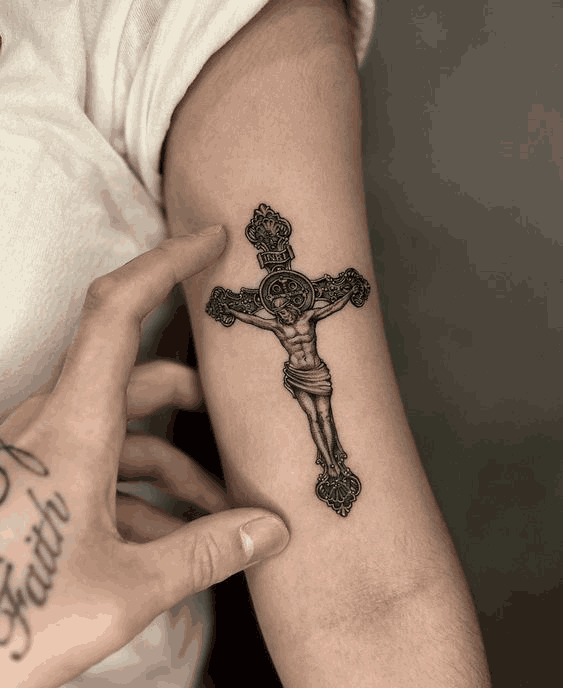
Fine-line work, like the cross-and-script piece above, has become especially popular for this category because it keeps the symbol legible and quiet rather than heavy-handed — a lot of clients want something they can see as a personal reminder, not a statement piece.

Mandala designs, like the sun mandala above, are usually built from repeating geometric patterns radiating out from a center point — a visual metaphor for balance that reads well as either a standalone piece or the anchor for a larger sleeve.
Cultural Sensitivity: Where — and Where Not — to Place a Sacred Symbol
This is the part of the conversation that doesn’t get talked about enough, and it matters most if you travel. In several Buddhist and Hindu-majority countries, images of the Buddha or other deities are treated as sacred, not decorative — placing one below the waist, on the feet, or in a way that could be seen as disrespectful can cause real offense, and in a few well-documented cases has led to visitors being asked to leave or even denied entry. Thailand and Sri Lanka in particular have a low tolerance for Buddha tattoos that are visible or perceived as casual; travelers with lower-leg or ankle Buddha tattoos have run into serious trouble at the border in the past. The same caution applies more broadly — a sacred figure on the sole of the foot, or paired with something that could read as mocking, is worth avoiding no matter which tradition it comes from.
None of this means you should skip a design you genuinely connect with — it just means it’s worth a real conversation with your artist first. A good studio will talk through placement, sizing, and context with you, and will tell you honestly if a particular symbol or position is likely to cause problems in the places you plan to visit or live.
Choosing the Right Studio and Artist
Because these pieces are so personal, the studio you choose matters as much as the design itself. Look for an artist who takes the time to ask why you want the piece, not just what it should look like — that conversation usually improves the final composition. If you’re deciding between locations, our page on tattoo price in Hanoi breaks down what to expect for fine-line and script work specifically, and our tattoo in Ho Chi Minh City page covers the same for our southern studio. Once you’ve picked a design and a location, our quick guide on how to book a tattoo covers everything from sending references to confirming your appointment.
Frequently Asked Questions
Do I need to be religious to get a religious tattoo?
No. Many clients choose these symbols for what they represent — protection, memory, balance — rather than as a declaration of formal faith. That said, it’s worth being thoughtful about symbols tied to traditions you don’t practice.
Is it disrespectful to get a Buddha tattoo if I’m not Buddhist?
It depends heavily on placement and intent. A respectful, well-placed design chosen with genuine appreciation is generally received very differently from one placed on the lower body or treated casually. When in doubt, talk to your artist and, if you plan to travel, research local norms first.
What’s the best style for a small, discreet religious tattoo?
Fine-line work is the most popular choice for this — a small cross, a single lotus, or a short scripture phrase in script all hold up well at a small scale and age more gracefully than heavily shaded pieces.
Can I combine symbols from different traditions in one piece?
It’s possible, but it takes a careful artist to do it respectfully and make it look intentional rather than random. Discuss the meaning behind each element with your artist so the final composition tells one coherent story.
RELATED POST

Phoenix Tattoo: Meaning, Rising Phoenix and Design Ideas
28 September 2026

Watercolor Tattoo: Styles, Design Ideas and How It Ages
25 September 2026

Fineline Tattoo: The Complete Guide to Delicate, Detailed Ink
22 September 2026

Stamp, Lantern & Hand Fan Tattoo: Meaning, Style & Design Guide
21 September 2026

Walk-In Tattoo Hanoi: Same-Day Designs and When to Book
20 September 2026

Asian Big Pieces Tattoo: The Complete Guide to Large-Scale Asian-Style Tattoos
20 September 2026